Observe
Recent robot, circuit, or grid measurements refresh the deployed state.
Compositional port-Hamiltonian world models
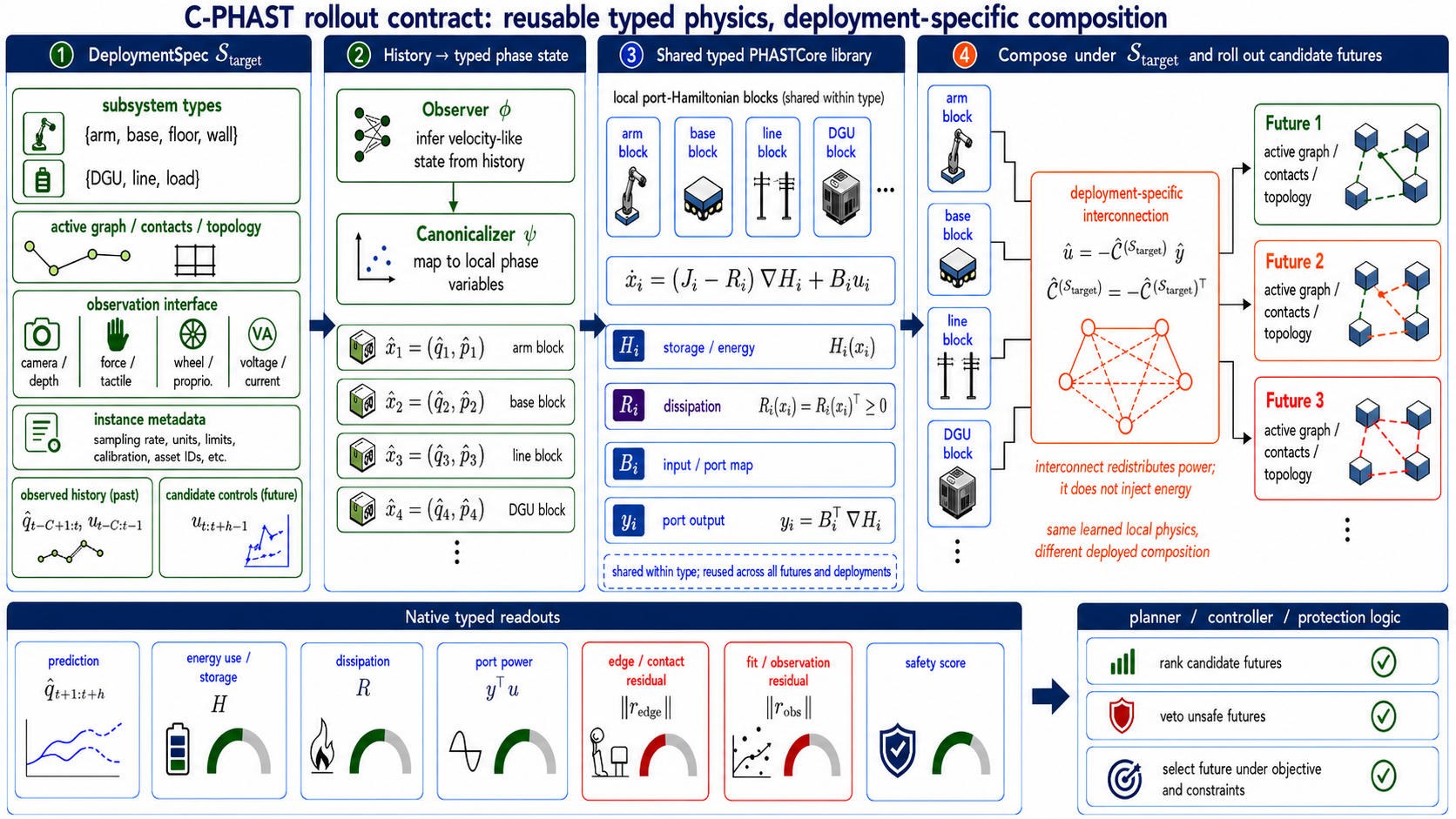
C-PHAST learns reusable physics blocks, recomposes them for a target deployment, and turns candidate rollouts into named physical consequences.
The model does not emit one opaque score. It predicts quantities a planner can reason about: energy use, support/contact margin, sensing value, voltage or current margin, and residual mismatch.
What the model exposes
A typed consequence is a named physical quantity with a role: reward, cost, safety envelope, or residual check. Objective cards reuse the same predicted consequences, then change weights or veto rules.
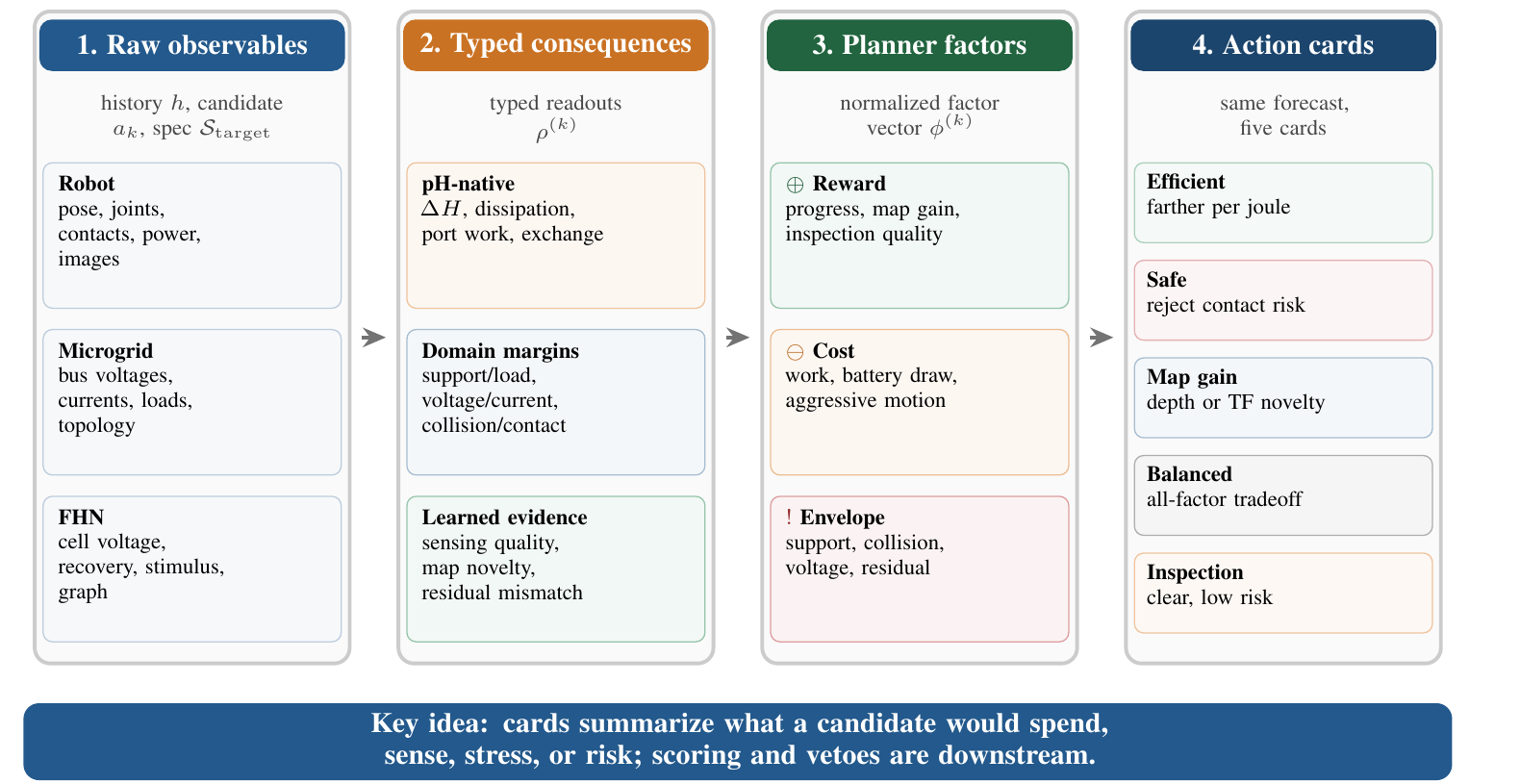
Recent robot, circuit, or grid measurements refresh the deployed state.
Candidate futures are simulated with the target blocks, graph, ports, and sensing interface.
Rollouts become physical readouts such as work, support margin, map value, voltage margin, or residual mismatch.
Downstream objectives turn the same consequence vector into action cards, rankings, or vetoes.
Real robot evidence
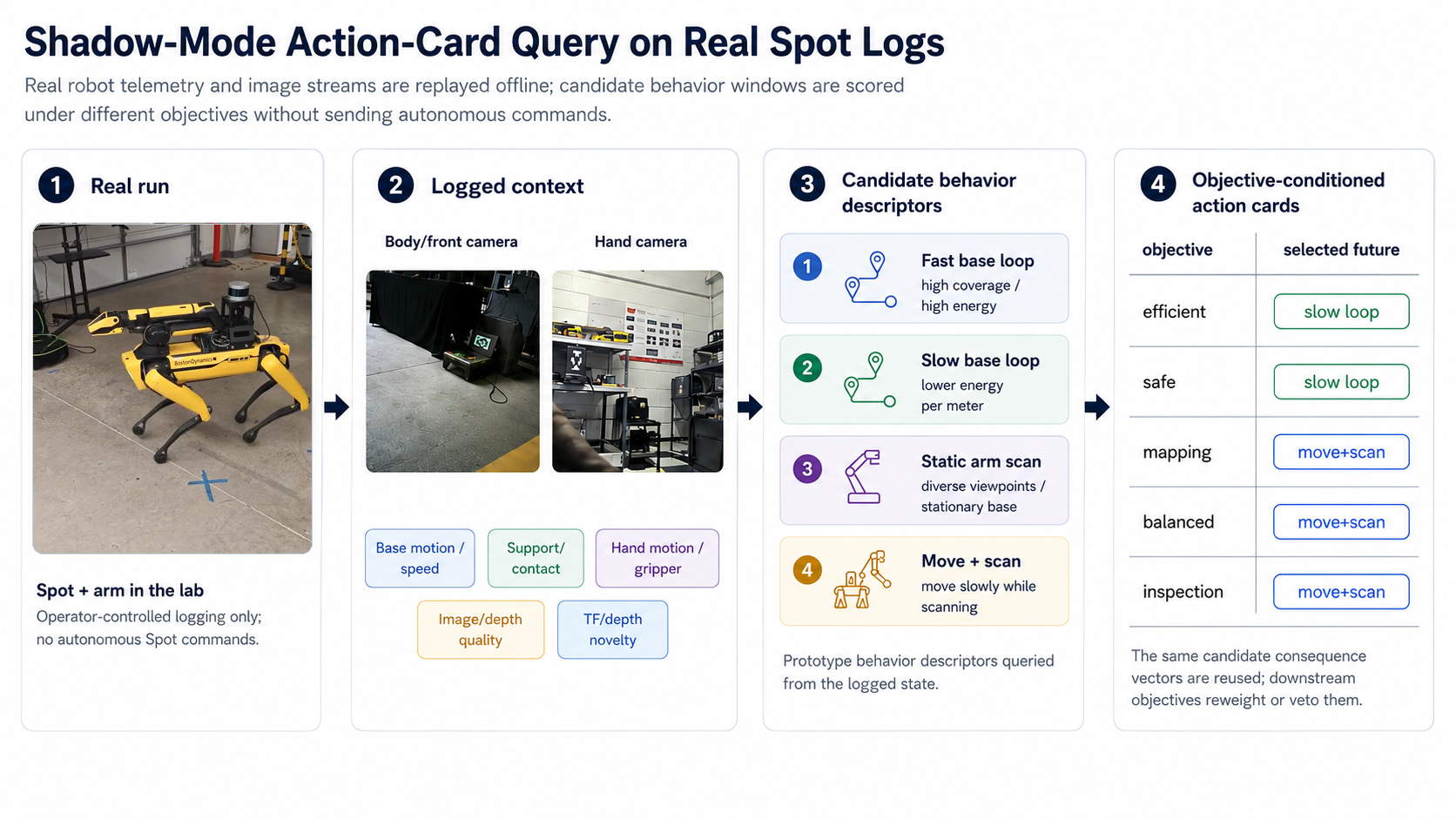
Six teleoperated Spot-with-arm episodes are replayed offline. C-PHAST reads recent telemetry and synchronized perception summaries, predicts named future consequences for a possible next behavior, and writes objective-conditioned action cards beside the logged run.
This is shadow mode: no autonomous commands are sent to Spot. The result validates the real sensing and decision interface, while the Isaac experiments below validate branchable same-state alternatives in simulation.
Branchable rollout evidence
Real logs show whether the interface works on hardware data. Simulator rollouts let us hold the state fixed and ask what would happen under alternative candidate futures.
Same contract, different physics
C-PHAST is not a single robot trick. The same contract appears as repeated joint or leg blocks, repeated excitable cells, and typed converter-line blocks in a power network.
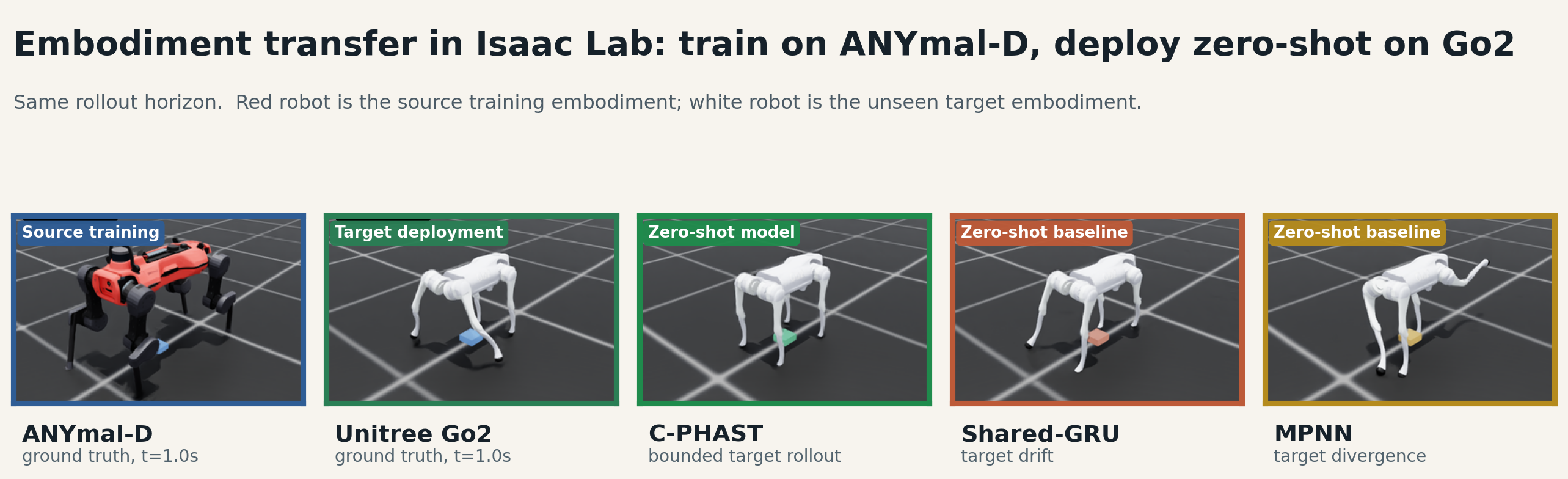
Reusable mechanical blocks are recomposed for a target embodiment and support/contact pattern.
FitzHugh-Nagumo chains test whether repeated cell blocks transfer under changes in cell count and diffusive graph.
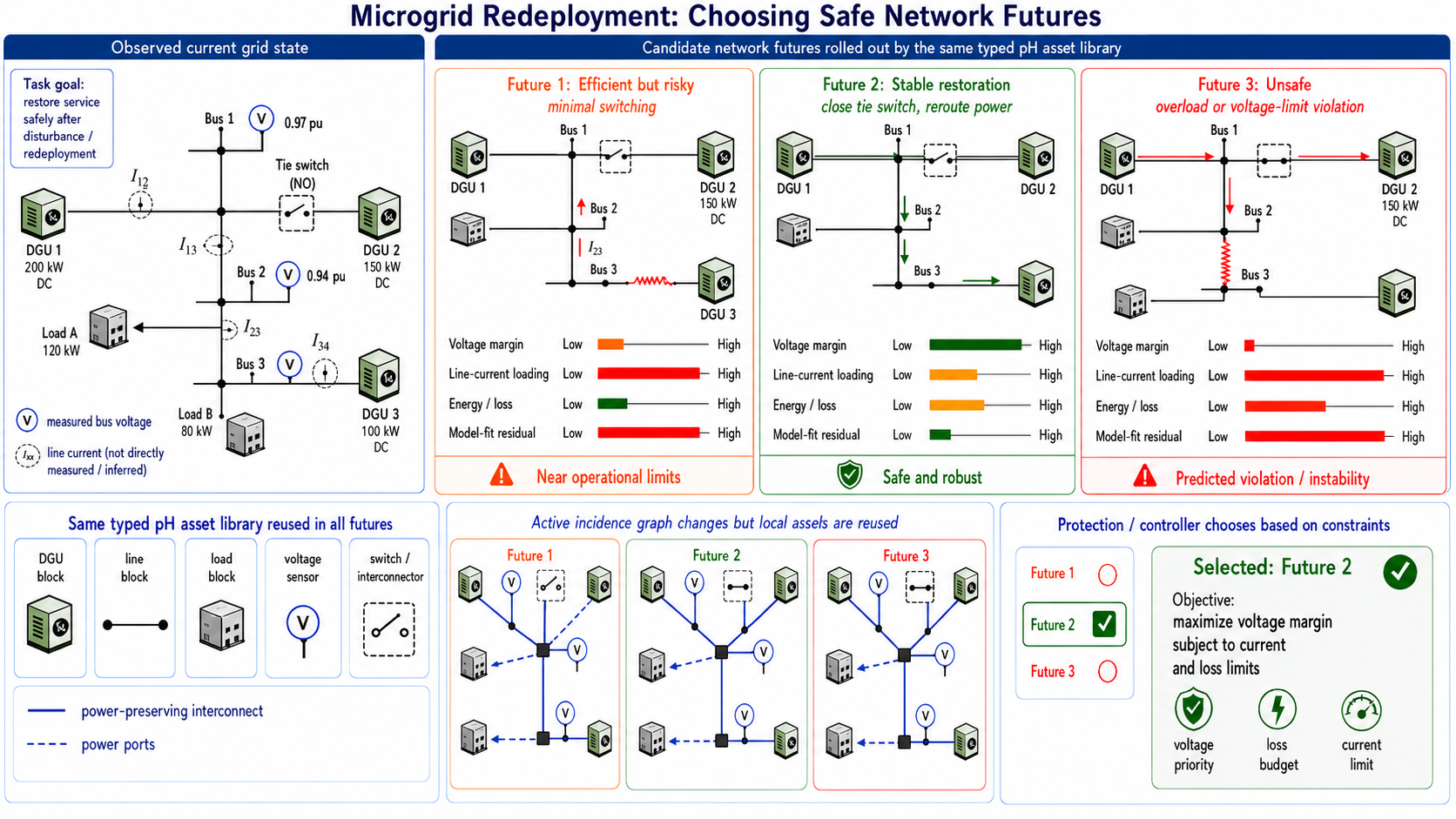
DGU node blocks and line edge blocks are recomposed under topology and sensing changes.
Model contract
The method separates local physics from the way a target system is assembled. This is why the paper can compare subsystem-count changes, cross-robot transfer, repeated excitable circuits, and microgrid topology or sensing changes under one interface.
Citation
@article{bhardwaj2026cphast,
  title   = {C-PHAST: Compositional Port-Hamiltonian World Models for Structured Dynamics Transfer},
  author  = {Bhardwaj, Shubham and Bajaj, Chandrajit},
  journal = {arXiv preprint},
  year    = {2026}
}